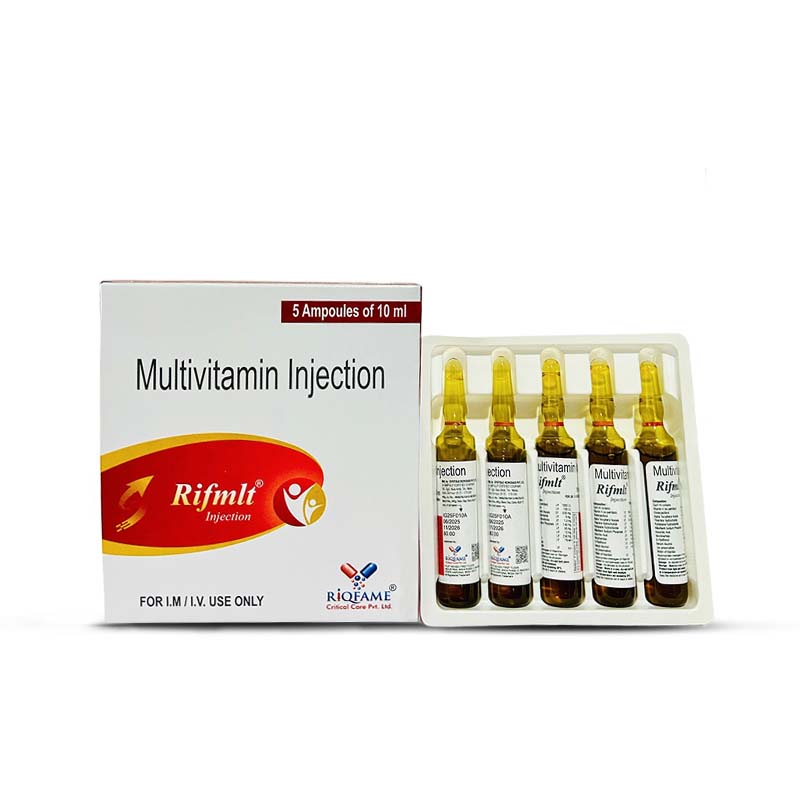
Multivitamin Injection 10ml: Essential Vitamin Support for Critical & Post-Operative Care
Multivitamin Injection delivers essential vitamins directly into the bloodstream. The human body needs vitamins to run every major metabolic process. Oral intake fails in ICU, post-surgical, and severe malnutrition cases. This injection covers that gap fast. RIFMLT supports energy metabolism, nerve function, tissue repair, and immune defense. For IM/IV use only, strictly under medical supervision.
Riqfame Critical Care holds ISO 9001:2015 and WHO-GMP certification across its injectable range. District-wise monopoly rights protect partner territories from direct competition. DCGI-approved products, consistent stock availability, and dedicated promotional support come standard with every partnership. Select zones are still open for serious franchise partners.
Product Overview: RIFMLT
- Dilute in IV fluid before administration.
- Hypersensitivity to any vitamin component: avoid.
- Renal or liver failure requires dose monitoring.
- Avoid mixing with alkaline IV solutions.
- Pregnancy: use under physician supervision only.
- Not for neonates: benzyl alcohol toxicity risk.
- Discard opened ampoules immediately after use.
- Store below 25°C, away from light.
Multivitamin Injection: Let’s Clear Things Up
Question 1. Why is a Multivitamin injection given instead of oral supplements?
Answer. Oral supplements depend on gut absorption. ICU and post-surgical patients lose that ability. IV or IM delivery skips the digestive system entirely. Vitamins reach deficient tissues much faster this way. Doctors choose injections when oral intake is simply not possible.
Question 2. Can a Multivitamin injection cause an allergic reaction?
Answer. Yes, though rare. Thiamine carries a small anaphylaxis risk via the IV route. Redness, itching, or breathing difficulty needs immediate attention. Emergency support should be ready during the first infusion. Doctors monitor closely, especially after the first dose.
Question 3. Is this injection safe for dialysis patients?
Answer. Yes, but vitamin selection matters here. Dialysis flushes out B-complex and Vitamin C regularly. This injection helps replenish those losses. Vitamin A accumulates in renal failure, doses need monitoring. A nephrologist decides the exact supplementation needed.